
In today’s crowded marketing landscape, brands are competing not just for attention but for lasting memory.
Traditional advertising, billboards, print ads, TV commercials, can create awareness, but awareness alone rarely guarantees recall.
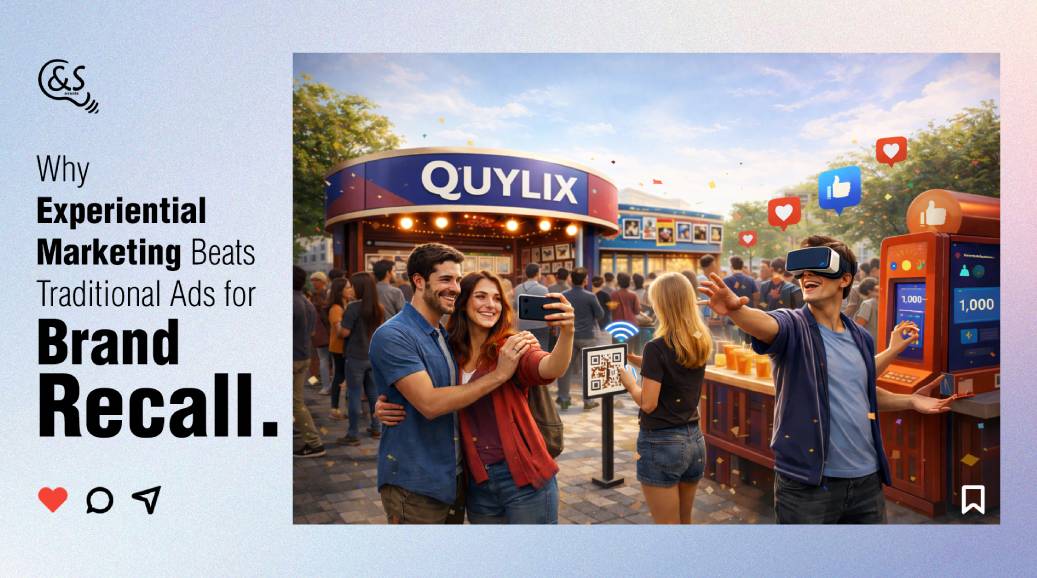
Experiential marketing, on the other hand, goes a step further. It transforms passive audiences into active participants, creating moments that people experience, remember, and share.
And that is exactly why experiential marketing consistently outperforms traditional advertising when it comes to brand recall.
The Problem with Traditional Advertising
Traditional ads operate in a one-way communication model. Brands deliver a message, and audiences receive it, often passively.
But modern audiences are exposed to thousands of ads daily across digital platforms, social media, outdoor media, and television. As a result, most messages blend into the background.
Even when an ad captures attention briefly, it often fails to create a deep emotional connection. Without that connection, the message is easily forgotten.
This is where experiential marketing changes the game.
Experiences Create Stronger Memory
Human memory is strongly influenced by emotion, participation, and sensory engagement.
When people interact with a brand through an experience, touching a product, participating in an activity, or engaging with a creative installation, the brain processes that interaction differently than a simple advertisement.
Experiential marketing activates multiple senses:
1- Sight
2- Sound
3- Touch
4- Emotion
5- Social interaction
The result is a multi-dimensional memory, which is far more likely to stay with the consumer long after the event ends.
In other words, people may see ads, but they remember experiences.
From Audience to Participants
Traditional advertising treats people as viewers.
Experiential marketing treats them as participants.
When consumers become part of the story, whether through an interactive booth, a live demonstration, a creative challenge, or an immersive installation, they develop a personal connection with the brand.
Participation leads to ownership.
Ownership leads to stronger recall.
Instead of remembering what the brand said, audiences remember what they did with the brand.
Social Amplification Multiplies Reach
Another advantage of experiential marketing is that experiences naturally generate organic content.
When people engage with creative activations or unique installations, they share those moments on social media through photos, videos, reels, and stories.
This turns one physical experience into hundreds or even thousands of digital impressions.
The difference is that these impressions are not traditional ads, they are authentic endorsements from real participants, which often carry far greater credibility and influence.
Emotion Is the Real Driver of Recall
Studies in consumer psychology consistently show that emotion drives memory.
Experiential marketing creates environments where brands can evoke emotions such as:
1- Curiosity
2- Joy
3- Surprise
4- Inspiration
5- Connection
These emotional triggers form stronger associations with the brand.
A consumer may forget a banner ad within minutes, but they are far less likely to forget the brand that gave them a memorable experience, a creative moment, or a meaningful interaction.
Data, Engagement, and Conversion
Beyond recall, experiential marketing also delivers actionable engagement.
Through tools like QR registrations, interactive stations, gamified experiences, and personalized content creation, brands can capture valuable consumer data while keeping the experience enjoyable.
This transforms experiential marketing from a simple awareness tool into a powerful lead-generation and engagement engine.
Brands are no longer just creating impressions, they are building communities, conversations, and long-term relationships.
The Future of Brand Engagement
As audiences become more selective about where they invest their attention, brands must move beyond traditional messaging and create moments that truly resonate.
Experiential marketing represents this shift.
It blends creativity, technology, storytelling, and human interaction to create experiences that audiences not only remember, but actively seek out.
In a world filled with ads, the brands that stand out are the ones that create moments worth experiencing.
Because when people experience a brand, they don’t just see it.
They remember it.
Unlocking Innovation: The Intersection of Creativity and Technology is where Magic happens
Creative management isn't just a strategy; it's the art of turning visions into experiences. Navigating the chaos, orchestrating the extraordinary - that's the dance of creative management in events. It's about thinking beyond the conventional, exploring unique themes, and conceptualizing experiences that resonate with the target audience. Our style of work involves staying agile, embracing change, and finding innovative solutions on the fly.

Architects of Unforgettable Experiences: Perfection is not just a Goal; it's a Standard
Every element of an event, from lighting and sound to stage design, undergoes rigorous scrutiny. The blueprint is not just a guide; it's a roadmap to perfection. Timelines are sacred, transitions are flawless, and the event flows like a well-choreographed symphony. We introduce innovative concepts, experiment with cutting-edge technologies, and redefine what is possible within the realm of event production.
Elevating Engagement: Where Brand Stories Come to Life
Events or exhibitions or activations - we share experiences that engage not only the eyes but all the senses. We immerse attendees in a multisensory journey. From captivating visuals to enticing aromas and dynamic sounds, every element is curated to leave a lasting impression. We seamlessly integrate brands into the event environment. From concept to execution, we redefine the ordinary, infusing each moment with creativity, passion, and a touch of magic.
Best of Both the Worlds: Connecting Global Audiences Globally
We continue to evolve with time, and the integration of virtual and hybrid platforms enables organizers to adapt to changing circumstances, reach wider audiences, and deliver engaging experiences in various formats. These platforms contribute to the overall transformation of how events are planned, executed, and experienced. As technology continues to advance, virtual and hybrid events are likely to play an increasingly integral role in the overall event landscape.
Bytes of Brilliance: Virtual Spark that Ignites Real-World Engagement
In the age of digitization, events are no longer confined to physical spaces—they're dynamic, interconnected experiences that leave a lasting impact. A world where physical limitations are no longer a barrier. Thanks to digitization, we can offer a seamless and eco-friendly experience. Attendees can access everything they need with just a few taps on their devices. At the same time, social media offers a multifaceted approach to promotion, engagement, and post-event sustainability.
Turning Gatherings into Opportunities: Responsive, Reliable, Reasonable, Reachable
Measuring ROI for events is crucial for organizations as it enables them to make data-driven decisions, allocate resources efficiently, and maximize the impact of their participation in events. With our strategic planning, correct approach, and multi-lingual call centre, we help generate holistic campaigns which in turn provides MQL and SQL leads.
